

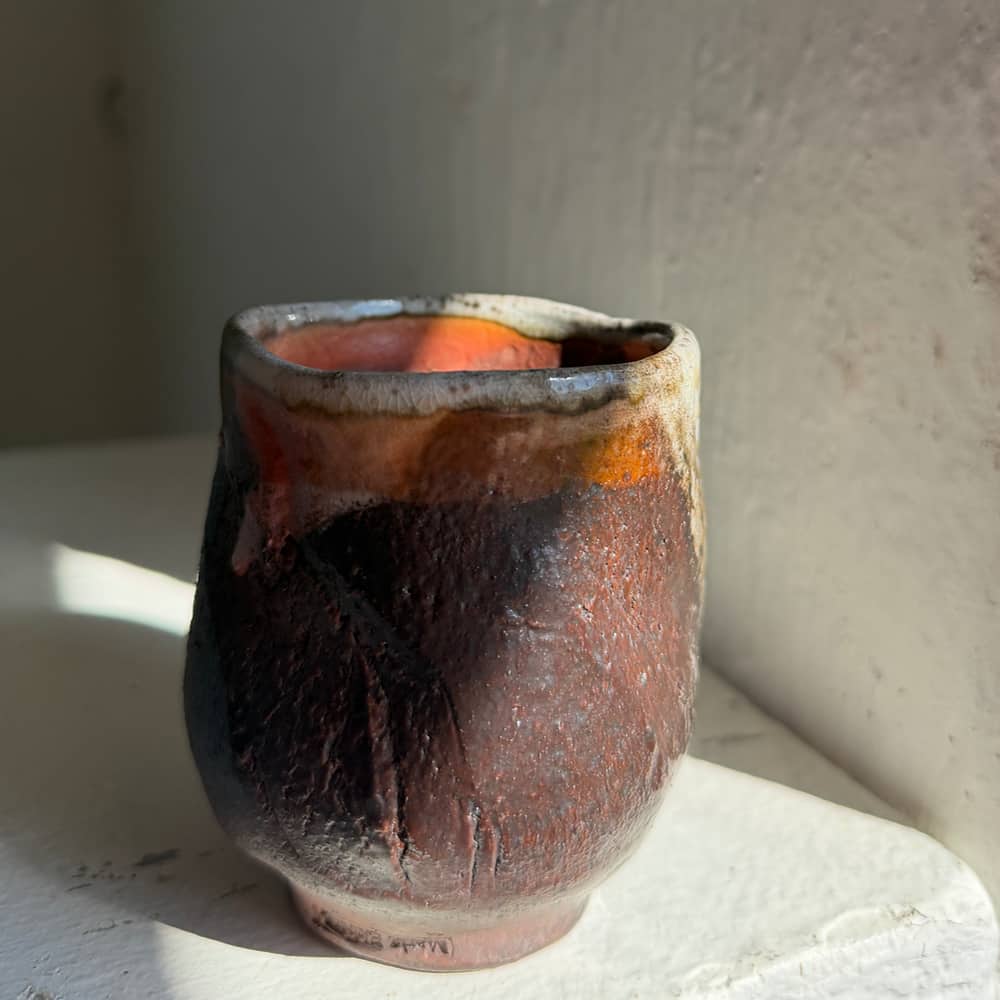
I often stand by the shelf in the gallery, getting a feel for the hand-thrown cups, one by one. Noting the weight, the surface, the glaze, the base, the shape. Turning them around. Setting them down. Picking them up again. Sometimes one gets to come along into the kitchen, and then it might become a new favourite that replaces the last. The only thing I really learn is that certain cups grow into being favourites over time. I’ve gone from liking thin mugs to appreciating more body, from structure to rough and organic.
That’s how I get to know them. A mug I didn’t like can become my favourite.
Because even though I throw them with roughly the same starting point, if rarely the same clay, I almost always have a new idea I want to try when I sit down at the wheel with the yunomi cups. A few thousand cups ago I thought I’d find ‘the cup’, the way I usually do with other forms. But the yunomi cups won’t be pinned down. Not in shape, not in pattern, not in glaze. They demand their own expression, and I dutifully follow along and create what the clay asks for.
The cups I throw don’t come alive until they’ve been fired. Before that they’re completely without personality, and since I’ve thrown so many, bisque-fired cups sit in boxes waiting for their final glaze firing. Sometimes I pick up a box and discard half of them, because they have a look I know I don’t want to repeat, even if the firing would turn out well.
And once they come out of the glaze kiln, it’s never quite the same cup. They’re all different and sit slightly differently in the hand. One has a rim that suits being drunk from in a particular way. Another has developed a surface that makes me pause every time I pass it.
In the wood firing, the differences become greatest of all. There, the flame and ash move through the kiln and leave marks that can never be repeated. The ash flies and settles wherever it finds purchase. The cup that stood closest to the fire doesn’t look like the cup that stood further back. And even its neighbours play a part – what shielded it, what was exposed.
That’s why I like going through the shelf like that. It’s not quality control. It’s getting to know my latest yunomi cups.
The gallery has both electric- and gas-fired cups, and cups from various wood firings. Just after midsummer I start my regular opening hours, but you’re of course welcome to get in touch at other times if you’re passing through Hammenhög in Österlen. If you stop by, feel free to do the same as I do. Pick them up one by one, turn them around and feel for the one that wants to come home with you.
That cup is out there, somewhere on the shelf. It’s just a matter of finding each other.